
Brief description of the monument
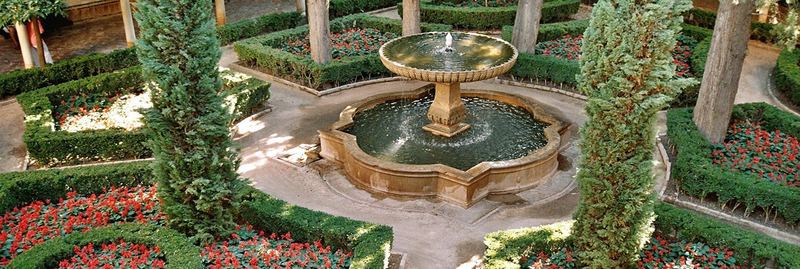
The Daraxa Garden, remodelled in the 16th century, is the one that best embodies the idea of the enclosed garden as a place of charm and delight. It has the sober style of Toledo courtyards, with its very Castilian gallery of posts and corbels. It is an irregular trapezium: two sides rest against the great palace of Charles V and the other two are closed by a portico. The centre is taken up by a beautiful Renaissance fountain; six flowerbeds edged with dense box hedges, each planted with cypresses and orange trees, crown the fountain and form a compact, dark mass that makes the effect of its water jet even more heavenly.
History of the monument
This garden, also called the Garden of the Orange Trees and the Garden of the Marbles, was laid out between 1526 and 1538, at the same time as the Rooms of Charles V were being built, on gardens that already existed between the palace and the wall. The courtyard is bounded to the south by the Daraxa Lookout and the Hall of the Two Sisters, to the north by the Rooms of Charles V, and to the east and west by the galleries built by the Emperor.
In the garden there are cypresses, acacias, orange trees and box shrubs surrounding the large central marble fountain. Like the fountain in the Court of the Lions, its rim is decorated with a poem; it was placed here in 1626, reusing the large basin that stood in the Court of the Golden Room.
To the south of the courtyard lie the basements of the Hall of the Two Sisters, a group of rooms around the Hall of Secrets. It owes its name to its acoustics: if two people stand in opposite corners and one whispers towards the corner, the other hears every word clearly, thanks to its sail vault.