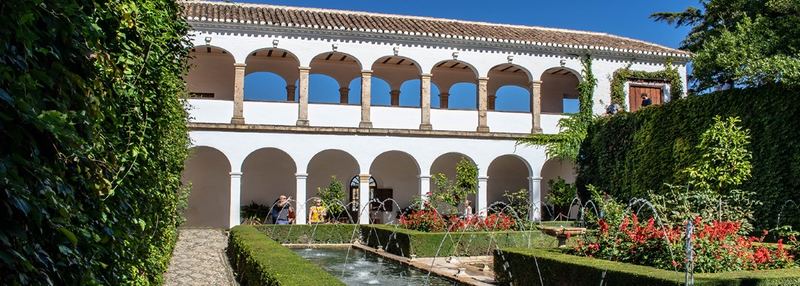
The entrance to the Generalife has a curious dual nature. On the one hand, its outward appearance is clearly rural, more like a farmhouse than a palace, matching the description of a Hispano-Muslim country estate (almunia) given by Ibn Luyun in his Treatise on Agriculture. On the other hand, it is entered through two successive courtyards on different levels, which clearly relates it to the entrance of the Alhambra palace itself.
The first courtyard, now called the Dismounting Court because of its benches for getting off horses, has two side wings that were perhaps used by the stable boys.
The second stands at a higher level and was originally surrounded by arcaded galleries on all sides except the central one, from which you climb up into the palace.
The palace itself is entered through a small doorway with marble elements and a tiled lintel, with the key motif repeated on the keystone of the arch. A staircase leads into the domestic quarters, arranged around the Court of the Water Channel and dominated by the North Pavilion. This opens with the usual arcaded gallery, with five arches and alcoves at each end, leading to the Royal Hall and the lookout of Ismail I.
In the Royal Hall the plasterwork, the niches (tacas) and the beautiful muqarnas capitals stand out. The layout of the room follows the usual pattern, with side alcoves framed by arches. The projecting muqarnas cornice beneath the wooden ceiling is particularly remarkable.
Gardens below the Generalife Palace
Below the North Pavilion of the palace there is a small enclosed garden that already existed in Arab times. In 1526 Andrea Navagero described it with ivy covering its walls and a fountain that threw water ten fathoms high.
To the west of this garden, and linked by stairs to the gardens below the West Gallery of the palace, which lie at a higher level, there is another small garden laid out in 1928 by Torres Balbás after the building attached to the North Pavilion was demolished.
To the west, along the whole gallery of the Court of the Water Channel and at a lower level, there are other gardens that appear in an engraving by the traveller Alexandre Laborde from the early 19th century, although with a different layout from today's.